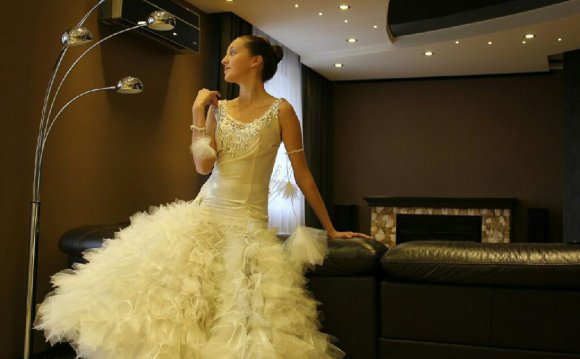
Juniors 1 Age Sports Dance
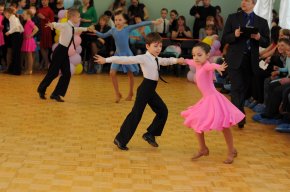 Local dance plays an important role in child aesthetic and physical education. This is linked to the multi-faceted bald dance, which combines the means of music, plastic, sports, physical, aesthetic and artistic and esthetic development and education.
Modern sports dances are presented with two programmes:
- ♪ European ", which includes dances such as slow waltz, tango, Vienna waltz, slow foxtrot, Quicstep;
- Latino-American, represented by Samba, Cha-cha, Rumba, Pasudul and Jaive dancers.
In addition, a club latin (mambo, salza, hastl) is being studied in the Radonez adult group.
A third of the total number of pupils in the first year of study is in the group. Groups are run by dance club teachers who have grown up not one generation of active sportsmen. During the first year of schooling, children from 4 years of age study the main figures sports, rhythmics, basic choreography.
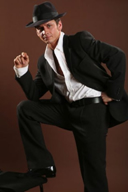 All classes are held to music, attention is paid to the development of a sense of rhythm and aesthetic perception of peace, plastics, coordination of movements, construction of the corps. The " Radonez " programme of work with young and middle-aged children enables pupils to participate in sports dance tournaments in categories H-3 (three dances), N-4 (four dances), N-5 (five dances) of the Moscow Federation of dance sports (FTC) and the Russian Federation of dance sports (FTC). Thereafter, dance duoes are formed from the Radonez Club to Moscow and all Russian tournaments. Today, the club is composed of children 1 (up to 9), children 2 (10-11 years), Union 1 (12-13 years), Union 2 (14-15 years), Youth (16-18 years), Adults (19 years and over).
The training focuses on two aspects:
- Tanks are a set of pieces and technical elements, as well as a qualitative implementation.
- The musicality of performance is from "incoming" to the rhythm of the dance to the sense of music, giving it some meaning and mood.


